
Le Tour
Let the Tour Begin
Welcome to Le Tour, a vivid, immersive introduction to the legendary Tour de France — cycling’s most iconic and demanding three‑week race. Every July, nearly 200 elite riders take to the roads of France and its neighboring countries, forming teams of nine and chasing glory across mountains, countrysides, and roaring crowds.
This page places you right at the starting line. You’ll feel the tension of countdown—cinq, quatre, trois, deux, un… you’re off!—and step into the world of the prologue, where riders launch individually from the start house to race contre la montre, against the clock. With fans screaming and adrenaline pumping, you push to maintain speeds near 35 mph, balancing power and endurance in a battle that demands absolute precision.
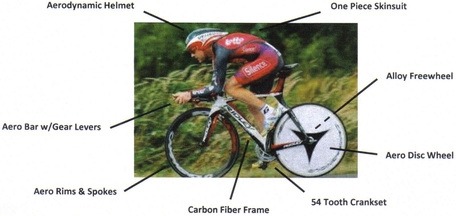
Your aerodynamic 'funny bike,' equipped with bullhorn handlebars and a rear disk wheel, is built for speed—even if it’s slightly heavier. Your pointed helmet and skinsuit help the air slip past as you fight to shave off fractions of a second. At the midway check, you’re just .001 seconds behind the fastest rider, a reminder of how razor‑thin margins define professional time trialing.
As your heart pounds like a jackhammer and your legs burn from anaerobic effort, you cross the finish line hoping your performance holds. Day 1 is nearly complete, and the journey ahead promises drama, strategy, teamwork, and the unpredictable magic that has made the Tour de France a global spectacle for over a century.
Whether you’re a lifelong cycling fan or discovering the Tour for the first time, this page offers a dynamic, sensory look at what makes the race extraordinary—from its traditions to its technology to the sheer human grit behind every pedal stroke.
Silky Smooth
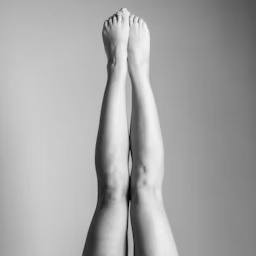
After a quick spike of electrolytes, you relax, take a shower, and then go for your masseuse. Just make sure your legs are shaven. Contrary to popular myth, there are three valid reasons why male cyclists shave their legs. First, to prevent injury. When a rider falls on an unshaven leg, it is actually the hair that does the most damage by pulling the skin resulting in a bloody abrasion. A clean-shaven leg slides smoothly along pavement resulting in no abrasion. Second, to decrease air resistance. In a sport where milliseconds matter, any advantage is welcomed. And third, smooth legs allow your masseuse to fully massage your tired thighs and calves, greatly increasing your recovery rate for the next day's trek. It's dinner time, and you are about to devour roughly 10,000 calories, no kidding. A typical pro cyclist's life is: waking up, eating breakfast, stretching, riding 100 miles, returning home, showering/masseuse, eating, a few hours in an endorphin-like trance, then going to sleep. In a sport where average body fat is nil, you are allowed to eat everything under the sun, and you indeed do.
Sacrificial Slaves
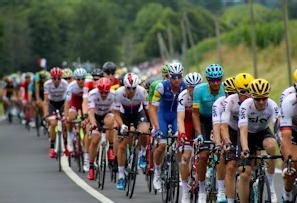
Back to the start line the next morning for a typical day's race length at 150+ miles. Your team plays a crucial role in the race, controlling the pace, breaking the wind, and relaying water. Most of the squad are called domestiques, who are basically high paid slaves. The domestique does most of the energy absorbing work, allowing the team leader to benefit.
And at the end of the day, the team's efforts ideally pay off, as their leader is either at the top of the GC (general classification) or close to it, racing the course in the least amount of time so far. Unless of course, you have two contenders for the lead, as was the case in 1986.
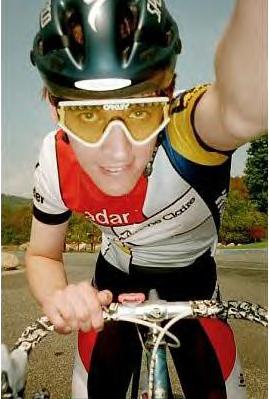
La Vie Claire, the colorful team sporting red, white, yellow, and blue fashion (see photo) was arguably "the best team ever, probably ever, in the history of the sport" according to teammate Andy Hampsten. Run by the French mogul Bernard Tapie, the team's budget was limitless, and could afford to pay high salaries to riders like Bernard Hinault, Steve Bauer, Niki Ruttiman, Jean-Francois Bernard, Hampsten, and of course Greg LeMond. As you can begin to see, having so many stars on one team can only mean fierce internal competition, and that's what happened. In 1985, Greg LeMond was forced to intentionally slow down on a Stage he could have won so as to assist team leader Hinault who was struggling. Had LeMond continued his pace, he would have won the day, and would have been the race leader. It was the first time in the history of the sport that a potentially victorious rider was told to slow down instead of speed up. Hinault went on to win the Tour and vowed to return the favor to LeMond the following year. But when the 1986 Tour unfolded, tensions once again mounted as both men had the chance to win the Tour. The 12-man team split friendships during the race; each rider siding with either the LeMond camp or the Hinault camp. And this occurred while they were supposed to be racing as one team in unison. Such is the price paid for victory in the Tour de France. LeMond went on to win, but with somewhat hesitant help from Hinault.
Flower Power
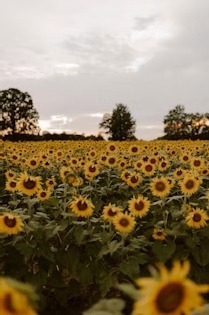
The traditional 'maillot jeune,' or yellow jersey, is donned onto each day's race leader. And you, my friend, are in yellow today. The first third of the race traverses mostly flatlands, where the heavy legged sprinters find their forte. Rain or shine, the race goes on. The gamble is, how fast are you willing to take a turn? Classic racing tires are called tubulars, or sew-ups, due to their internally sewed in tube. Weighing in at an incredibly light weight, they offer the advantage in weight savings at the most crucial spot, wheel rotation. The lighter your tires, spokes, and nipples are, the easier it is to rotate the wheel, therefore the energy saving ratio is significant. Tubulars are glued onto a wheel's rim, and your mechanic had better ensure they are glued on securely. Rolling a tire off of its rim on a turn is, shall we say, not an adventure you want to experience. But enough of these redundant corn and sunflower fields, you want to see the snow. The mountains are approaching.
The Mountains
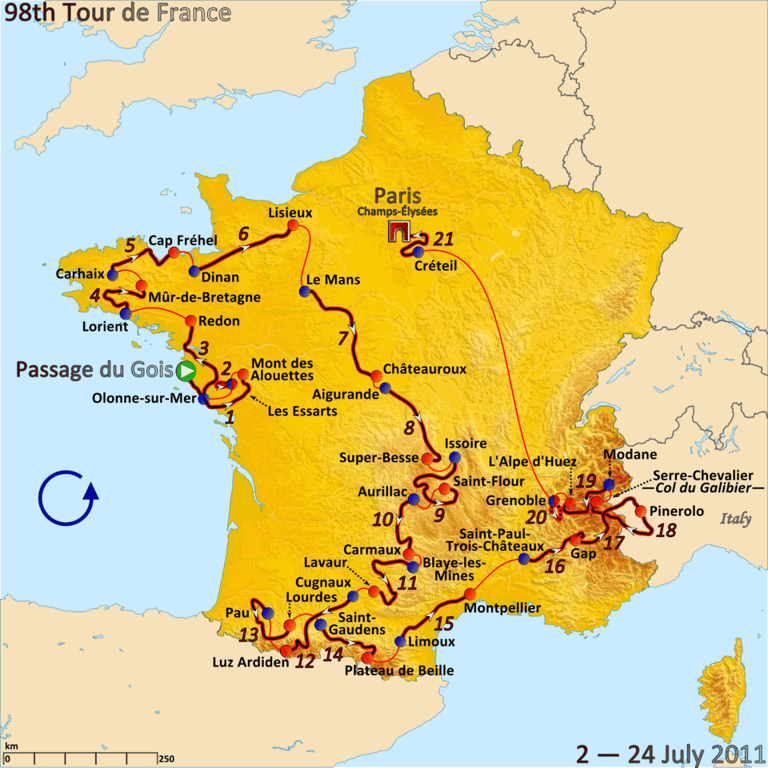
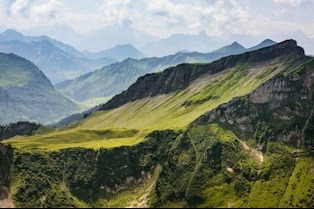
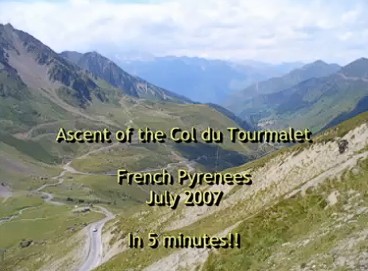
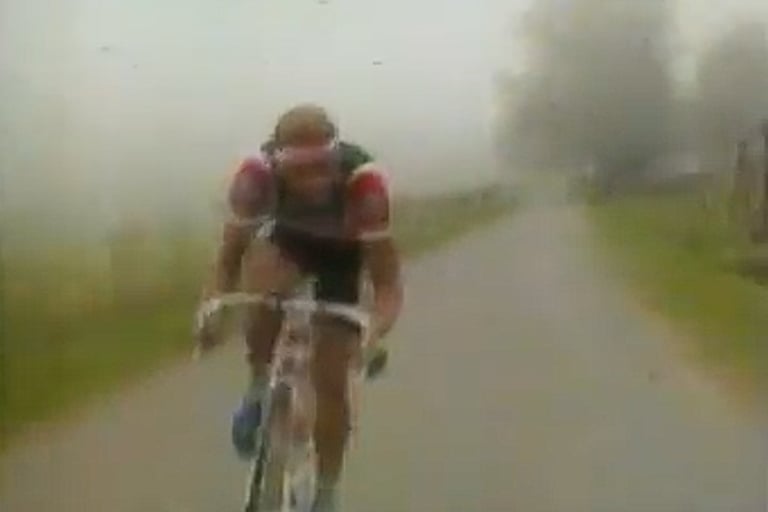
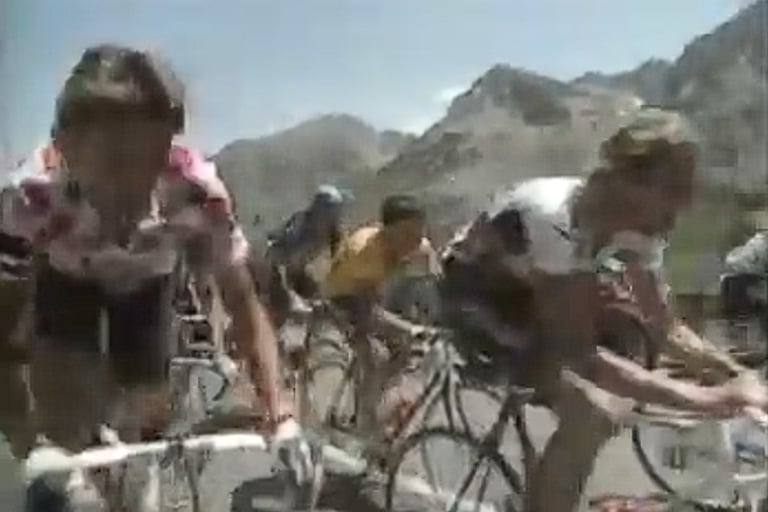
Two to three sets of mountain stages are scheduled in the Tour de France. Depending on the clockwise or counterclockwise route of the whole race, you will be climbing over such colossal monsters as the Col du Tourmalet (see video), Superbagnères, Col de Portet d'Aspet, and Luz Ardiden (see videos) in the majestic Pyrenees which border France with Spain. The second set of mountains take place in the Alps, where you will climb over a row of shark's teeth such as Alp d'Huez (see video), Col de la Croix de Fer, and the Col du Galibier, the highest road in France. And sometimes, just sometimes, tour organizers throw in a bowl of cherries in the form of Mont Ventoux and its neighboring extinct volcano climbs in France's Massif Centrale region. Well, who determines how hard the race will be? Politics are everywhere, even at the Tour. Every year towns all across France bid on being either a starting point or a finishing point for a particular stage. The highest bidders win of course, which brings publicity to their town and some degree of notoriety. Paris of course, receives an automatic entry for the race's final stage finishing point. However, some argue that the entire race route is disproportional and unfair. To climb a mountain and to pedal the flatlands should not be timed on the same clock, as clearly it is much more difficult to ascend against gravity, thereby sharply separating those who are 'billy goats' from those who are 'snails.'
You've made it over the penultimate peak and descending at 60mph. Instantly you realize the important ruling made rather recently requiring helmets to be worn on all stages, as you recall Motorola's Fabio Casartelli, who crashed on a high-speed descent, cracking his head, and losing his life. You keep a safe distance behind the rear wheel of the rider in front of you, and it is only your descending skills that prevent you from overshooting a corner and catapulting over the guard rail, if there even is one. The feed zone approaches several miles before the final summit climb and you grab a bag of hi-energy goodies to fuel up for the nightmare ahead. With merely a few stages to go in this great race, if you fail to make it over this peak, you are dropped and full of tears. With legs burning, you must keep the pace with your rivals, who will intentionally attack your vulnerability on the HC (Hors Categorie) climb. An HC climb is the most difficult climb classified in the tour. With throngs of people absolutely mobbing you with encouragement, you cannot even hear yourself think. Your only objective is to reach the summit finish. You are experiencing the definition of pain. Once across the finish line, you fall from your bike but luckily your attendees are there and immediately slap an oxygen mask on your face. You are lucky to be semiconscious.
Drug Tripper
During the race, many riders find that sleeping in an enclosed chamber specially designed to acclimate their bodies to the rarified atmosphere of the mountains does indeed work. Still other riders, like Andy Hampsten, rely on a fresh supply of Mexican food favorites to do the trick. And still other riders rely on...something else.
"Got a good reason, for takin' the easy way out. Got a good reason, for takin' the easy way out now. She was a..."
Drug tripper, not quite the exact line from that famous Beatles song, but appropriate enough indeed. Drug use in the Tour de France has a long history, and a sad one. In a sport where physically testing a body's limit is par for the course, combined with a direct connection between salary and results, it is no wonder then why performance enhancing drugs are rampant. Amphetamines were the drugs of choice through the 1970s, combined with caffeine through the 80s. More recently, such substances as testosterone and erythropoietin (EPO) have been added. This is in addition of course to the well-known 'natural' technique of blood doping, which is extracting your blood, refrigerating it for a while, then injecting it back into your body, which by this time has regenerated the lost RBCs (red blood cells), resulting in an increased RBC count in your bloodstream. RBCs carry oxygen to weary cells, so the more you have, the more you can endure. Several riders have been caught via unannounced sporadic testing, but, the crook is always one step ahead of the cop, isn't that correct? With the help of team physicians, riders have found clever ways at beating the rap. One way, only a theory of mine and never proven, involves the strategic use of the domestiques. Remember these guys are the work horses for the team, all focused on getting their leader at the top of the GC. A technique that is plausible is for these domestiques, maybe one or two of them, to be intentionally loaded up on either testosterone, EPO, or another substance and to then nurse the team leader through about three quarters of the race, after which they drop out of sight and purposely finish back in the pack. The net effect is that the team leader, who had no reason to take drugs, has just had three quarters of the day's work done for him (breaking the wind, water supply, etc.) by the drugged domestiques. The team leader finishes with a fast time, and for that he is automatically tested with a urine test. The faster you are across the line, the more chance that you will undergo testing. About three randomly selected riders are also chosen from all regardless of finishing time, but the chances that one of these domestiques is picked is small since the field is large. The leader finishes strong, tests clean, and the team physicians chalk up another victory for themselves. It is a terrible tragedy but as long as money rules, rules will be broken.


Victory
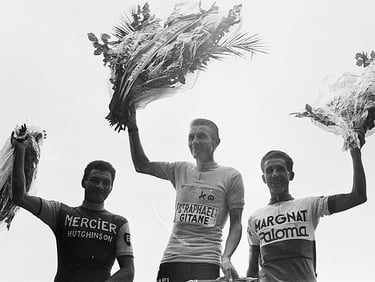
Not to take away from you and the majority of riders who are dedicated professionals though. You've trained and raced 100 miles a day for 9 months out of the year in the toughest sport on the planet. Now you are racing the final stage into Paris. Once again, the cheering crowds welcome you from your gladiator-like battle over the past three weeks. The field rounds the Champs d'Élysées and then in a dramatic burst of effort collectively vault out of the saddle and dig hard for the most prestigious stage win in all of cycling. Afterwards, you can only reflect on the man standing atop the podium with trophy in hand, and, you wish that this man was you.
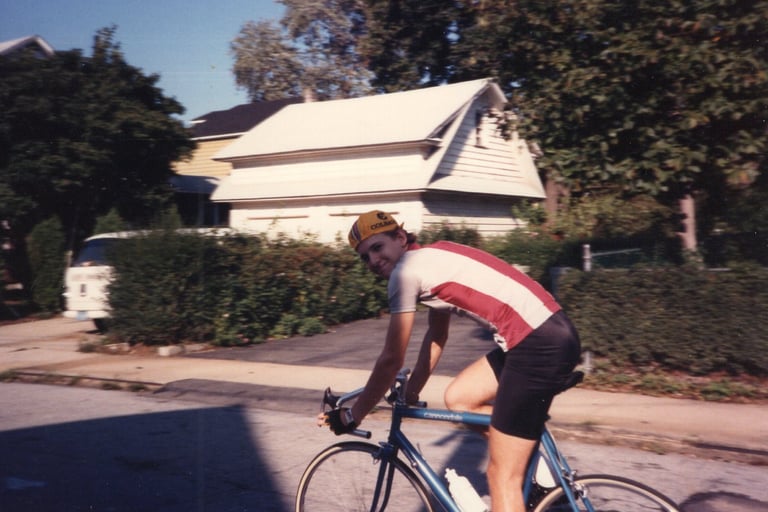
From 1986 through 1994 I held a United States Cycling Federation (USCF) international racing license which allowed me to compete in a handful of races in France. I remember going out on a training ride with my friend Gerard. The first thing that raised my eyebrows was the sheer bravado of the typical European cyclist. Whereas I was exhibiting 'proper American style' athletic preparation like stretching and eating fructose-based food, my friend here just got on his bike cold after downing a buttery croissant. Needless to say, he kept the pace and was even eager to push it. A young buck you might say? No, because another person I went biking with, who was the father of a lovely French girl I knew, took me on a cycling tour through the rolling countryside into parts unknown, and he was 60+ years old.
I remember in one race I was in a 5-rider breakaway pack heading to the finish only 2km from the picturesque town of Cazères, France with about 90 seconds lead on the peloton (main group). Glancing over my right shoulder, nobody in sight. Thirty seconds later, the tsunami-like peloton quickly engulfed us, chewed us up and spit us out, plain and simply put. European cycling is fierce, so hats off to all who compete.
Got Compliment or Curse?
Reach Out
Spindleless@AOL.com
© 2026 All rights reserved